


Heated Concrete Flooring Toronto by Heavenly Heat
- Cost Efficient Operation!
- Shovel Less During Winter!
- Retain Driveway Quality!
- Environmentally Friendly Solution!



Basement slabs, condo floors and modern main floors in Toronto are often concrete, and bare concrete feels cold for much of the year. Heated concrete flooring turns that slab into a warm, durable floor with a clean, modern look.
Heavenly Heat has designed and manufactured electric floor heating in Vaughan for more than a decade. Toronto homeowners, builders and flooring installers order our cable, mats and thermostats directly or through tile stores and dealers, for two kinds of projects:
Our team helps you choose the right method, prepares a free layout drawing with the cable length and wattage for your floor, quotes the materials and ships the order to your site. Your flooring installer and a licensed electrical contractor put the system in, and our technical support line is open Monday to Friday while they work.
A heated concrete floor system is electric cable or hydronic tubing embedded in concrete, or in a thin layer over it, controlled by a thermostat with a floor sensor. The table compares the three common builds.
| Build | Where the heat sits | Added height | Warm-up | Best fit |
|---|---|---|---|---|
| Electric cable in a new slab | 2 to 3 inches below the surface | None | About 2 to 4 hours | New builds and additions |
| Electric mat or cable on an existing slab | In self-levelling compound over the slab | About 1/4 to 1/2 inch | Faster, especially over insulation | Basement and main-floor renovations |
| Hydronic tubing in a slab | In the slab, fed by a boiler | None | Slow, best on a steady schedule | Whole homes and large areas with a boiler |
Polished concrete moved from warehouses into homes because it is hard-wearing, easy to clean and looks modern. On its own, though, it has one practical drawback: it feels cold underfoot.
Heat solves that. Concrete’s high thermal mass makes it a strong partner for radiant heat, because it absorbs heat, spreads it evenly and releases it slowly, so a heated slab keeps rooms comfortable between cycles. The same slab also works under tile, stone and other hard finishes.
Most rooms with a concrete floor can take heat, including basements, kitchens, bathrooms, mudrooms, open living areas and secondary suites. The layout is drawn to fit the room, with cable kept clear of cabinets, tubs, toilets and floor drains, and split into zones where parts of the space are used at different times. Basements need the most care, because an uninsulated slab loses heat to the ground, so an insulating layer under the mat is worth the extra height.
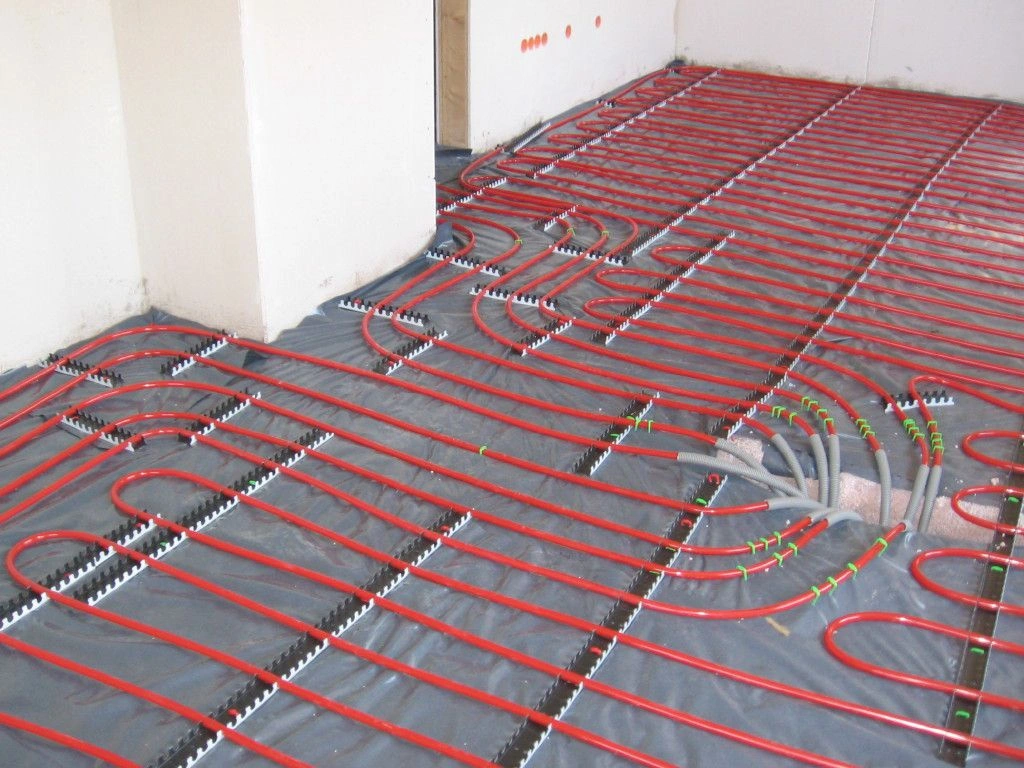
Pick the system by the job. Electric cable suits single rooms, renovations and spaces without a boiler, since it needs only a circuit and a thermostat. Hydronic systems pump heated water from a boiler through PEX tubing and make sense when a whole new house or a large slab is being heated.
Then match the floor covering. Tile and stone transfer heat best, while laminate, vinyl and engineered hardwood work within the temperature limit their makers set.
Open-plan floors, lofts and large basements are where radiant heat earns its place, because a heated slab puts the heat where people are instead of at the ceiling. Split a large area into zones, each with its own thermostat, so the kitchen can run on a different schedule from a family room you rarely use.
Embedded cable has no moving parts and needs no routine service. Upkeep is about the controls and the surface: check the thermostat schedule at the start of each heating season, confirm the floor sensor reading looks right, and reseal polished concrete as its maker recommends.
Keep the resistance readings from installation with your house records, and check the layout drawing before drilling into a heated floor.
Toronto Pearson averages about 130 days a year with an overnight low at or below freezing, according to Environment and Climate Change Canada’s 1991 to 2020 normals, and basement slabs stay cold for much of that time. A heated slab handles a long cold spell well, because its stored heat carries the room through each cycle.
Because a slab takes hours to respond, a thermostat schedule that starts the heat before you need it works better than turning it up when you already feel cold.
Want more information on heated concrete floors? Our floor heating team answers technical questions Monday to Friday. Heating an outdoor slab instead? Our snow melting systems go into concrete driveways and walkways. Call 1-877-523-5667 for a quote.

Our team is dedicated to providing excellence in every aspect. Trust us for a seamless experience like no other.

All our products are made of top notch grade components. With efficiency and reliability in mind, our heating systems meet the highest industry standards.

Our trained and experienced staff is readily available to answer any of your technical and customer service related questions.
Concrete takes several forms as a finished floor, and each one changes where the heating cable goes and how much height the floor gains.
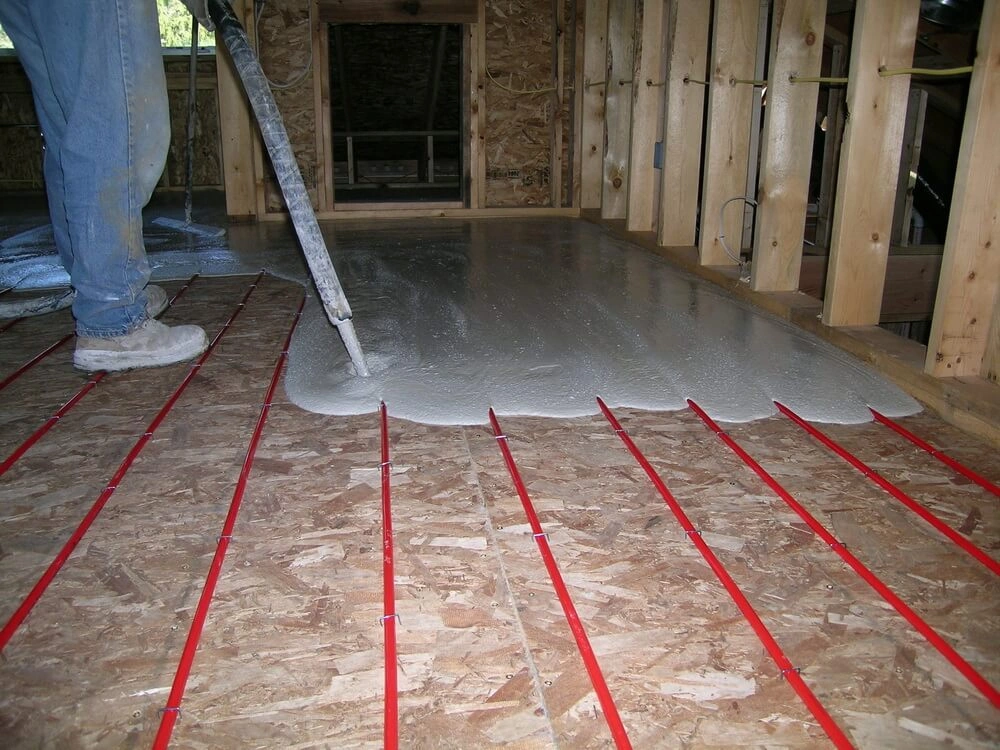
A full-depth slab is poured, cured, then ground and polished. With heat, the cable is tied to the mesh before the pour, typically 2 to 3 inches below the surface of a slab at least 4 inches thick, and kept below the depth the polisher plans to grind.
This finish is a thin cement-based layer poured over an existing subfloor. Check the product sheet first: a self-levelling underlayment must be covered by another floor covering, while a self-levelling topping is rated as a wear surface and can be the finished floor.
Over a worn or damaged concrete floor, a thin polished overlay creates a new surface. Over heating cable, the overlay must be a product its maker approves for radiant heat, with the cable fully below the depth the polisher will grind.
Concrete holds heat well. Its thermal mass stores warmth and releases it slowly, so the floor stays comfortable after the heating system cycles off. The trade-off is time: a thin mat under tile warms in about 30 minutes, while a heated slab takes roughly 2 to 4 hours to come up to temperature.

In a new build, electric in-slab heating is the most direct route. Heating cable is fastened to the reinforcing mesh or a cable guide, the concrete is poured over it, and a floor sensor is set between two cable runs to report the slab temperature to the thermostat. Because a slab responds slowly, it suits rooms used every day, where the heat can run on a steady schedule.
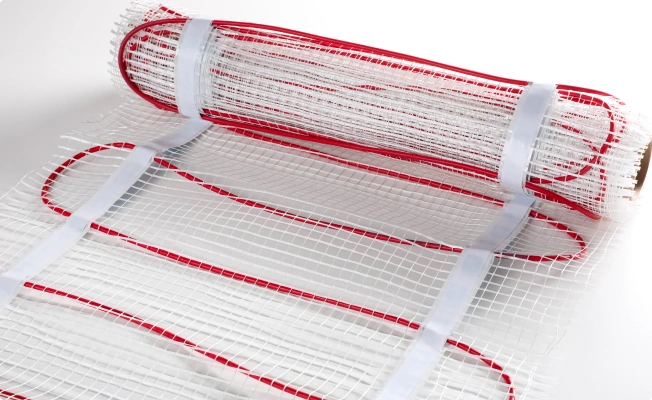
For an existing slab or subfloor, the cable cannot be cast into the concrete. Instead, the Easy Mat, only 1/8 inch thick, or Easy Wire is laid on the slab, ideally over an insulating underlayment, and covered with self-levelling compound. The floor rises by about 1/4 to 1/2 inch, and the heat sits right under the floor covering, where it warms the room faster.
Radiant heated concrete flooring works in new construction and in renovations, but the method changes with the slab you start from.
New construction is the easiest time to add heat, because slab depth, insulation and cable layout can all be planned before the pour. Bring the other trades in early: the concrete contractor needs the cable layout, the electrical contractor needs the circuit and thermostat location, and the saw-cutting crew needs to know where the cable runs. Cable must never cross a saw cut, control joint or expansion joint, so mark the cut lines on the base with spray paint before the cable goes down.
Existing concrete floors can be heated without breaking them up. The slab is cleaned and primed, an insulating underlayment goes down where height allows, and the Easy Mat or Easy Wire is fixed in place and covered with self-levelling compound. Tile then goes on with thinset, or engineered hardwood, laminate or vinyl goes over the cured compound with the right underlayment. A thermostat with a floor sensor keeps the temperature within the limit each floor covering allows.
Before a renovation, check two things. First, a concrete topping adds weight, so confirm the structure can carry it, especially over a wood-framed floor. Second, check what is under the slab. An uninsulated basement slab sends heat into the ground: a Radiant Professionals Alliance example showed nearly a quarter of a radiant floor’s output lost downward, and the loss climbs where groundwater sits under the slab.
The cost of heated concrete flooring depends on the heated area, the output per square foot, whether the project involves a new slab or an existing floor, the insulation, the thermostat and the electrical contractor’s work. Running cost depends on when the slab charges. From November 1, 2026, the Ontario Energy Board’s Ultra-Low Overnight price is 3.7 cents per kWh from 11 pm to 7 am, against 37.7 cents during the weekday 4 to 9 pm peak, so heating the slab overnight and letting its thermal mass carry the room through the evening can cut the energy charge sharply.
For a free quote, send us the floor plan, the floor covering and the subfloor type, and our team will prepare a layout drawing with the cable length and wattage your project needs. Call 1-877-523-5667.
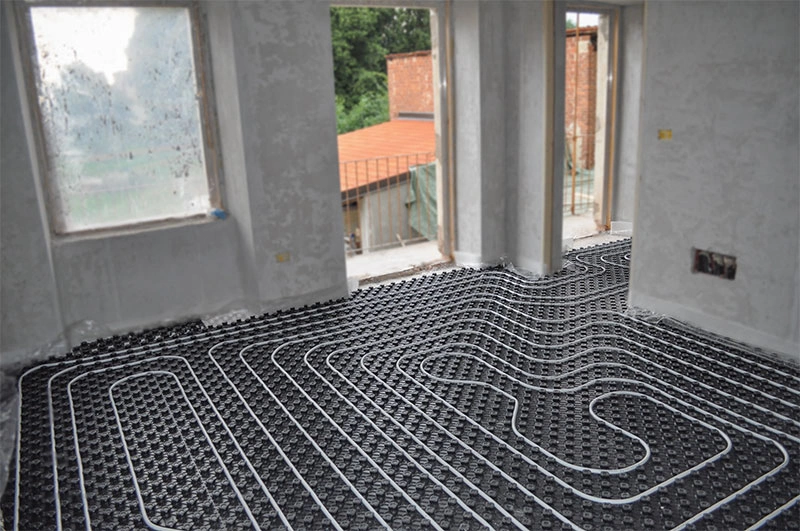
Electric heating cable, or hydronic tubing carrying heated water from a boiler, warms the concrete from inside. The slab then radiates that heat into the room, warming people and objects with no forced-air drafts and no ducts.
Insulation decides how much of that heat reaches the room. Ontario’s 2024 Building Code, in force since January 1, 2025, lists R-10 (RSI 1.76) under a heated slab in the SB-12 prescriptive energy tables for Zone 1, which includes Toronto, plus R-10 at the slab edge. Rigid foam under the slab and around its perimeter keeps the warmth moving up instead of into the ground.
Installation follows a set order: insulation first, then the cable or mat, then the concrete or self-levelling compound. Your concrete contractor or flooring installer places the system, a licensed electrical contractor makes the connection and files a notification with the Electrical Safety Authority, and Heavenly Heat supplies the cable, mats, thermostats and layout drawing.
Three rules protect the system:

The best floor heating supplier in Toronto is not the one with the cheapest cable. It is the company that makes its own CSA…

Every Toronto winter follows the same script: the plow comes past at 6 a.m., the end of your driveway disappears under a metre of…

A heated driveway in the GTA costs about $16 to $37 per square foot installed in 2026 — roughly $9,600 to $22,200 for a…

As a DIY, I really appreciated the snow melting cable from Heavenly Heat because it is so heavily jacketed I had no trouble with damage, testing the cable before and after proved that it withstood whatever it had to during installation. I love that it has a built-in return connection; meaning the cable doesn’t have to make the “run” back to the relay panel – this made the install so much easier.


Amazing product! We installed easy mat in a family room. The family room was part of an addition that was on a slab so the room was extremely cold especially in the winter. We used the mat under pad and carpet and it heats up in minutes. We are thrilled with how this product performs.

Extremely well made and truly an excellent product. Couldn’t be happier with customer service at Heavenly Heat.

Ordered floor heating cable. Works well. A great solution for an odd shaped space and the price is great. We installed it in a bathroom floor that is above and unheated garage. Just the right solution.
It was a pleasure dealing with Heavenly Heat during home renovation project. Customer support was excellent, advising on how-to (I hired electrician at the end to install the system at the end, but still they were very helpful). Over all very positive experience.
Awesome floor heat system. I have installed Heavenly Heat as well as a couple other brands and this one for the price cannot be beat. It also comes with extras that the more expensive systems do not come with such as the alarm to let you know if you have damaged the cable during installation. The thermostat takes a bit of time to learn and is not as easy, but once you figure out how to program it, its no problem. Will definitely buy again. The floor is already nice and warm.
Good quality and much cheaper than many heating cables out there. No problem at all. I didn’t use the installation strips but bought uncoupling membrane. It makes it much easier to install since you can remove the cable and move them closer. Keep in mind you cannot cut your cable. There is some trial and error until the coverage is perfect with your cable length. Thermostat works well too and is programmable with many options.
Amazing product. Glad I went with these guys.

An awesome heating system, we used it in our bathroom renovation project; and honestly, after hours of research I couldnt find anything else even near the same quality for the same price. Would absolutely reccomend.

I’m very happy with Heavenly Heat team. It’s my 3rd project with this team and I’m always happy with their work.

Give us your contact information and we’ll be in touch


